

How Much Of The Government's Money Is Going Towards Welfare 2016 America
Prophylactic Net
Condom CyberspaceWelfare and the Federal Budget
· July 25, 2017
University of Maryland
The Outcome:
Every bit the Trump administration has been preparing a federal budget and Congress has been talking about tax reform, there has been much attention to the federal budget and federal regime spending priorities. One notion that has surfaced in the surrounding political soapbox is that the federal government ought to spend less on welfare help to low-income individuals to both reduce regime spending and to promote economic cocky-sufficiency. Critics have pointed at traditional transfer programs such as the Temporary Assistance to Needy Families and the Supplemental Nutritional Assistance Plan. All the same, especially since the changes brought in by welfare reform in the mid-1990s, federal transfer programs provide very little aid by way of cash assistance to not-working adults. At the same time, social insurance programs including Inability Insurance accept been relatively at the margin of reform debates. However social insurance programs are a much larger share of the federal budget and accept been seeing steady increases in the populations they serve, potentially having negative impacts on employment.
How much does the federal government spend on welfare assist to low-income individuals? What are the existing eligibility criteria to authorize for these programs? And, what evidence is there for negative employment impacts of these programs?
Since welfare reform in the mid-1990s, federal transfer programs provide very picayune assist by mode of cash assistance to non-working adults.
The Facts:
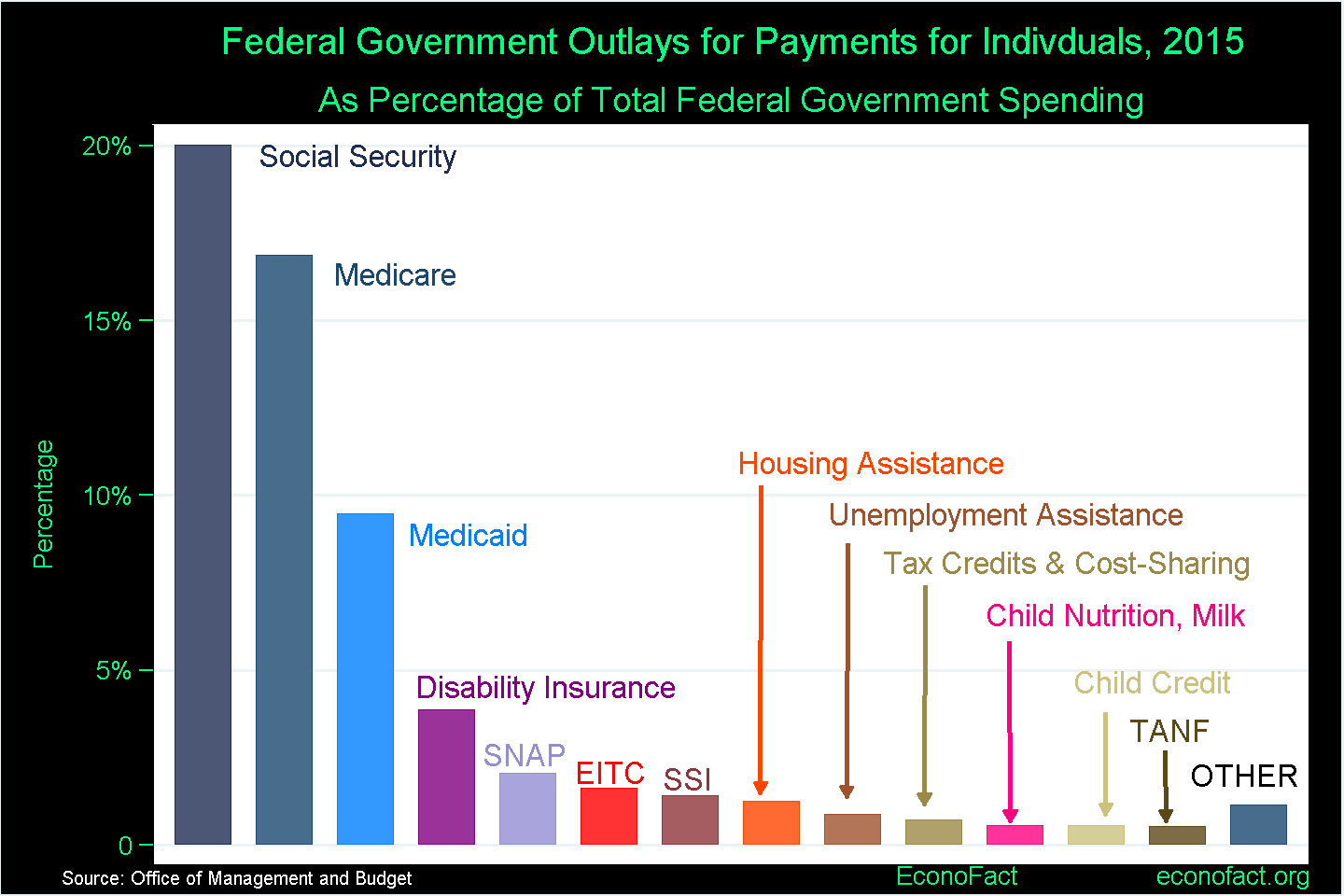
- Spending on greenbacks and near-cash transfer programs to depression-income families comprises less than five pct of the federal budget. These programs are not drivers of increased government spending (see chart). The program that most closely aligns with the conventional notion of "welfare" in the sense of providing greenbacks income to depression-income families – is the Temporary Assistance to Needy Families (TANF) program. In 2015 spending on TANF amounted to 0.54 percent of total federal outlays, amounting to $19.9 billion. In comparing, payments of tax refunds through the Earned Income Tax Credit (EITC) – a cash payment that is only paid to tax filers with low, but positive earnings –amounted to $60.1 billion, one.63 percent of federal outlays the aforementioned twelvemonth. Spending on income assist programs to depression-income families is dwarfed by spending on social insurance payments to the elderly through the Social Security and Medicare programs.
- TANF is non welfare in the traditional sense of unrestricted cash payments to non-working individuals. The program is time-limited and imposes work requirements on beneficiaries. TANF was implemented equally part of the 1996 welfare reform legislation that effectively "ended welfare as we know it" by eliminating the former Aid to Families with Dependent Children program (AFDC). In 2017, an estimated two.6 million individuals were receiving TANF benefits per month. Like AFDC, eligibility for greenbacks payments from TANF is limited to children and adults with child dependents. Different AFDC, TANF is not an entitlement program and has strict work requirements and time limits. Federal rules impose a lifetime limit of 60 months of TANF receipt for a family unit with an adult recipient, and some states have stricter time limits. Current rules too crave that 50 pct of adult TANF recipients in a land must participate in specified work activities. Exempt individuals typically include the elderly, the ill or incapacitated, and expectant mothers in their third trimester (encounter this study for TANF piece of work requirements). Currently, merely one-third of TANF spending is on cash assistance. The federal government pays TANF funds to states primarily through a fixed block grant and states have flexibility in determining how much of their TANF funds are paid out to families as cash assistance or used for other types of assistance, such as child care or transportation subsidies, refundable land EITC payment, work supports, etc. Do good amounts vary widely beyond states, with the median maximum monthly do good for a family of three in 2012 being $427. Numerous academic studies have investigated the caseload and employment effects of the shift that happened every bit part of the 1996 welfare reform legislation. The consensus finding from this literature is that the shift from AFDC to TANF led to higher employment rates among the target population of single-mothers. (Come across here for a detailed review of TANF and academic show on program furnishings.)
- The Supplemental Nutritional Assistance Program (SNAP), which is one of the nation's largest anti-poverty programs, offers limited help to non-working able-bodied individuals without dependents. In 2015 the federal government spent $76.ane billion on SNAP, slightly more than than 2 pct of total federal outlays, providing food vouchers to an average of 45.8 million individuals a month. Boilerplate monthly benefits per person in 2015 were $126.81 (data available through the U.S. Section of Agronomics run across here for the most recent summary table). SNAP, formerly known as "Food Stamps", has come under a great deal of scrutiny, with critics viewing the relatively high (by historical standards) SNAP caseload every bit evidence of swollen welfare spending. Though SNAP benefits take the grade of food vouchers rather than cash, SNAP is a crucial income back up program, in part because information technology is the simply income support program not categorically restricted to certain groups of individuals. SNAP eligibility rules are quite restrictive for non-working prime-age (eighteen to 49 years old) able-bodied adults without dependents (ABAWDs). Most are restricted to 3 months of benefits within a three-year period if they are not working or in a grooming program at least 20 hours per week. This feature of the programme is essentially tantamount to a piece of work requirement for childless adults (see here for a thorough review of SNAP and research on its effects). By statute, the time limits imposed on non-working ABAWDs are relaxed during periods when unemployment in a state is loftier, as was the case in near states during the Bang-up Recession. There is no compelling evidence that SNAP outlays atomic number 82 to a sizable reduction in employment rates, in detail amid men. (Run into hither for detailed employment impacts of the introduction of the food stamp program in the early 1960s and 1970s.) Because the program responds to changes in the economic system, spending on SNAP increased significantly during the Great Recession just has been decreasing every bit the economy has been improving.
- Although they are not typically considered welfare programs, the Social Security Inability Insurance (SSDI) plan and the Supplementary Security Income (SSI) program are major sources of income assistance in the U.S. Both are social insurance programs administered through the Social Security Administration and they have seen sizable increases in their casher populations over recent decades.
- The federal regime had SSI program outlays of $52.3 billion in 2015 – comprising i.42 per centum of federal outlays – providing federal benefits to 9.03 million people. (For data meet Tables 1, 2, and 3 hither). The maximum monthly federal benefit amount was $733 for an eligible individual. SSI essentially operates 3 programs for distinct populations: bullheaded or disabled children, bullheaded or disabled non-elderly adults with limited earnings history, and individuals 65 and older (without regard for disability condition). Approximately 1-in-six SSI recipients are under the historic period of 18, 1-in-four are 65 or older, and the remaining threescore pct are betwixt the ages of 18 and 64. The fraction of not-elderly adults receiving SSI benefits has increased substantially over time, from 1.5 percent in 1988 to 2.5 percent past 2013 (see here for details).
- Does the SSI programme lead to lower rates of employment among beneficiaries and their family members? The design of the SSI program potentially discourages labor supply among non-elderly recipients by requiring a medical disability diagnosis and low levels of earnings. To the best of my knowledge, in that location is no prove of sizable dis-employment furnishings of the SSI program on working age adults (see this review I co-authored for an overview of the program and a review of research on its effects). This is non surprising, every bit not-elderly adults who participate in SSI take very low pre-plan employment rates. There is a dissever event of whether the SSI program for children reduces parental employment. Rigorous evidence suggests that the removal of a kid'southward benefits leads to a sizable increase in parental earnings. A related study shows that child recipients who themselves are removed at age eighteen are not readily able to transition into stable employment as young adults. Though SSI spending is a relatively small share of the federal budget, given the potential dis-employment effects of the SSI children's program, both for parents of SSI child beneficiaries and children transitioning off the program as adults, there is justification to consider a re-evaluation of the design of the SSI children's program.
- The federal Social Security Inability Insurance (SSDI) program paid out $143 billion in greenbacks payments to viii.91 million beneficiaries in 2015, according to data from the Social Security Administration. Spending on SSDI accounts for 3.89 percent of the federal budget, making it the merely cash assistance programme other than Social Security Sometime Age and Survivors Insurance (the Social Security retirement program) that comprises more than than two percent of the federal budget. SSDI replaces the lost earnings of qualifying individuals with significant work histories. Medical eligibility for the program requires a inability diagnosis, divers by the SSA as "the inability to engage in substantial gainful activity because of a medically determinable physical or mental impairment that is expected to last at least 12 months or result in death." By definition, the program is designed for long-term receipt, and in practice, very few beneficiaries exit the program for a reason other than death. (Just most 1 percent of beneficiaries are removed from the rolls based on wellness improvements, according to this study.) DI benefit amounts are adamant as a function of prior earnings using the aforementioned formula as is used for Social Security retirement benefits. The wage replacement rate is xc percentage of the start $826 dollars of prior monthly earnings, 32 percent of monthly earnings between $826 and $iv,980, and xv percent of monthly earnings higher up $4,980. The average monthly cash benefit amount for a disabled worker was $1,165 in 2015. In add-on, DI beneficiaries automatically authorize for Medicare benefits, making the total transfer corporeality much higher.
- Does the SSDI program lead to lower rates of employment amongst beneficiaries and their family members? The share of working-age Americans receiving SSDI benefits has increased significantly, ascent from 2.2 percent in the late 1970s to three.6 percent in the years immediately preceding the 2007–2009 recession and 4.6 percentage in 2013 (see here for an analysis of this increment). There has been a corresponding change in the composition of DI recipients, with more recipients claiming benefits for hard-to-verify impairments such as mental conditions and back pain, and with the program providing a safety net backdrop for low-skilled workers with weakened economic prospects (meet here). Researchers aspect the tremendous growth in the DI caseload to a combination of policy, economic, and demographic factors. There is compelling bear witness that the beingness and electric current benefit construction of the DI program have caused some individuals with weak labor forcefulness attachment to work at lower rates than would otherwise be the case (see for instance hither, here, here, and here).
If policymakers have dual goals of reducing federal government spending and reducing cash support for not-working individuals to increase employment rates, a focus on welfare programs that provide income support to low-income families is misplaced. Those programs institute a tiny share of federal spending and already have stringent piece of work requirements. Instead, policymakers should focus on social insurance programs, namely, reforming the Social Security Inability Insurance program, which is by far the largest source of cash help to non-working, non-elderly individuals and comprises three.9 percent of the federal upkeep. Well-designed reform of the SSDI program could have both a substantial positive fiscal impact on the federal budget besides as the economical cocky-sufficiency of individuals currently served past the program.
Source: https://econofact.org/welfare-and-the-federal-budget
Posted by: usherseentacts.blogspot.com
0 Response to "How Much Of The Government's Money Is Going Towards Welfare 2016 America"
Post a Comment