

How Many Simple Random Samples Of Size 5 Can Be Selected From A Population Of Size 8?
One of the most common questions I get asked by people doing surveys in international development is "how big should my sample size be?". While at that place are many sample size calculators and statistical guides available, those who never did statistics at university (or take forgotten it all) may find them intimidating or difficult to utilize.
If this sounds like you, then keep reading. This guide volition explain how to choose a sample size for a basic survey without whatsoever of the complicated formulas. For more easy rules of thumb regarding sample sizes for other situations, I highly recommend Sample size: A crude guide past Ronán Conroy and The Survey Inquiry Handbook by Pamela Alreck and Robert Settle.
This commodity is a short introduction to the topic for a more than in-depth coverage of the topic consider enrolling in the costless online course offered by University of Florida.
This advice is for:
- Basic surveys such equally feedback forms, needs assessments, opinion surveys, etc. conducted as part of a programme.
- Surveys that utilise random sampling.
This advice is NOT for:
- Research studies conducted by universities, inquiry firms, etc.
- Complex or very large surveys, such equally national household surveys.
- Surveys to compare between an intervention and control group or earlier and after a plan (for this situation Sample size: A crude guide).
- Surveys that use non-random sampling, or a special type of sampling such every bit cluster or stratified sampling (for these situations encounter Sample size: A crude guide and the UN guidelines on household surveys).
- Surveys where you program to use fancy statistics to analyse the results, such every bit multivariate analysis (if yous know how to practise such fancy statistics then you should already know how to choose a sample size).
The minimum sample size is 100
Most statisticians agree that the minimum sample size to get any kind of meaningful event is 100. If your population is less than 100 then y'all really need to survey all of them.
A expert maximum sample size is usually ten% every bit long as it does not exceed 1000
A expert maximum sample size is ordinarily around x% of the population, as long as this does not exceed yard. For instance, in a population of 5000, 10% would be 500. In a population of 200,000, 10% would be 20,000. This exceeds 1000, and so in this case the maximum would be yard.
Even in a population of 200,000, sampling grand people will normally give a fairly authentic consequence. Sampling more than 1000 people won't add much to the accuracy given the extra time and money it would toll.
Choose a number between the minimum and maximum depending on the situation
Suppose that you want to survey students at a schoolhouse which has 6000 pupils enrolled. The minimum sample would be 100. This would give you a crude, only still useful, thought about their opinions. The maximum sample would be 600, which would requite you a fairly accurate thought about their opinions.
Choose a number closer to theminimum if:
- You have limited time and money.
- You only need a rough judge of the results.
- You don't plan to dissever the sample into different groups during the analysis, or y'all simply program to use a few big subgroups (due east.thou. males / females).
- Yous recollect most people volition give similar answers.
- The decisions that volition exist made based on the results exercise not have significant consequences.
Choose a number closer to themaximum if:
- You have the time and money to do it.
- It is very important to get accurate results.
- You lot plan to divide the sample into many different groups during the analysis (e.thousand. unlike age groups, socio-economical levels, etc).
- You think people are probable to give very different answers.
- The decisions that will be made based on the results of the survey are of import, expensive or have serious consequences.
In exercise most people commonly want the results to be every bit accurate as possible, so the limiting gene is usually time and money. In the instance above, if you had the time and money to survey all 600 students and then that will requite y'all a fairly accurate result. If you don't have plenty time or money then only choose the largest number that you lot tin can manage, as long equally information technology'southward more than than 100.
If you lot would similar to acquire more than near Survey Information Collection consider taking the free course offered past Academy of Michigan and University of Maryland. Enroll here.
If you want to be a scrap more scientific then apply this table
While the previous rules of pollex are perfectly acceptable for most bones surveys, sometimes y'all need to sound more "scientific" in lodge to be taken seriously. In that case yous tin utilise the following table. Simply cull the column that virtually closely matches your population size. Then choose the row that matches the level of error yous're willing to have in the results.
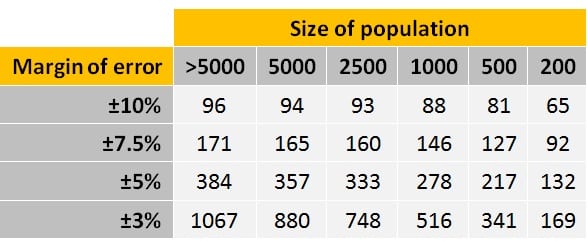
Y'all volition see on this table that the smallest samples are still around 100, and the biggest sample (for a population of more than 5000) is even so around 1000. The same general principles utilise every bit earlier – if you plan to divide the results into lots of sub-groups, or the decisions to be fabricated are very important, you should pick a bigger sample.
Notation: This table can only exist used for basic surveys to measure what proportion of the population have a particular characteristic (e.yard. what proportion of farmers are using fertiliser, what proportion of women believe myths virtually family planning, etc). It can't exist used if you are trying to compare two groups (due east.g. command versus intervention) or two points in time (east.g. baseline and endline surveys). See Sample size: A rough guide for other tables that can be used in these cases.
Relax and stop worrying about the formulas
Information technology's a dingy fiddling hole-and-corner amidst statisticians that sample size formulas oft require you to have information in advance that you don't normally accept. For instance, you typically demand to know (in numerical terms) how much the answers in the survey are likely to vary betwixt individuals (if you knew that in advance then you wouldn't be doing a survey!).
Then even though it's theoretically possible to calculate a sample size using a formula, in many cases experts still terminate upwards relying rules of thumb plus a good bargain of common sense and pragmatism. That ways you lot shouldn't worry too much if you can't use fancy maths to choose your sample size – you're in good company.
One time you lot've called a sample size, don't forget to write proficient survey questions,design the survey form properly and pre-test and pilot your questionnaire.
Photograph by James Cridland

How Many Simple Random Samples Of Size 5 Can Be Selected From A Population Of Size 8?,
Source: https://tools4dev.org/resources/how-to-choose-a-sample-size/
Posted by: usherseentacts.blogspot.com
0 Response to "How Many Simple Random Samples Of Size 5 Can Be Selected From A Population Of Size 8?"
Post a Comment